
-
Cleveland Lead Safe Certification FAQs (Updated for 2024 Program Changes)
The City of Cleveland has made significant changes to the Lead Safe Certificate program. These updates took effect on October 18, 2024 and affect every rental property built before 1978. Below are the most common questions property owners ask, along with clear explanations based on the updated guidance.
Cleveland Lead Safe Certification FAQs
Answer: To apply for a Lead Safe Certificate, the owner must first obtain a Lead Risk Assessment completed by a licensed lead risk assessor. Clearance exams alone can no longer be used to start the certification process. Once the assessment is complete, the owner submits it through the Accela Portal along with the application.
Answer: The City of Cleveland determined that clearance exams were not reliably identifying lead hazards. Several children were found to have elevated lead levels while living in recently certified properties where peeling paint was still present. The law requires the City to certify a rental only when no lead hazards were identified. Because a clearance exam does not identify hazards, it no longer meets the legal standard. A Lead Risk Assessment is now the only acceptable method to determine whether hazards exist.
Answer: A Cleveland Lead Risk Assessment includes:
- Visual inspection of interior and exterior painted surfaces
- Assumption that all painted surfaces contain lead unless proven otherwise
- Dust wipe sampling where required
- Documentation of the severity and location of hazards
- A corrective action table (HUD Form 5.7 or equivalent)
This report is used by the City of Cleveland to determine whether the property qualifies for a 2 year certificate or whether lead remediation is required.
Lead remediation is any work (including cleaning) done to reduce lead hazards. There are two types of Lead Remediation though Lead dust hazards can always be present.
- Interim Controls are temporary mitigation strategies that need to be monitored including an environmental clean, at minimum, covering bare soil (mulch), and stabilizing deteriorated paint.
- Abatement is the longer-term mitigation strategy that can last up to 20 years. It includes removing and replacing components (i.e. windows & doors), or covering large surfaces including walls, ceilings, & exposed soil (i.e. remove and replace soil or pave-over) to ensure property is free of all traces of lead.
To comply with the new lead-safe law, the remediation process employs interim control activities to address researched and tested signs of lead risks and hazards. Interim controls are measures that are taken to ensure a property is lead safe.
If hazards are identified, the City of Cleveland will issue a citation that gives the owner 90 days to begin corrective actions. Owners must show progress every 90 days by submitting documentation. Examples of progress include:
- Hiring a contractor
- Completing individual repairs
- Applying for grant funding
If the owner does not show progress, the City may issue penalties or take further enforcement action.
Answer: Yes. You can still apply and begin the process. You will not receive the certificate until hazards are addressed, but the assessment allows you to move into the compliance cycle and complete the repairs over time while remaining in communication with the City of Cleveland.
Answer: No. A full lead inspection with an XRF device is required only if you are seeking a 20 year exemption. For the standard 2 year certificate, a Lead Risk Assessment is sufficient.
Answer: Clearance exams are still used, but only in specific situations. A clearance may be performed after non-abatement or abatement work to confirm that hazards have been controlled. However, a clearance exam cannot be used to start a Lead Safe Certificate application unless it was performed before October 18, 2024 or unless it follows abatement activities.
Answer: To qualify for a 20 year exemption, the owner must obtain a full Lead Inspection and Risk Assessment using an XRF device. This requirement has not changed.
Answer: If your clearance exam was completed before October 18, 2024, the City will still accept it. The date of sample collection must match the date on the report. Any inspections performed after that date must follow the new rules.
Answer: The City of Cleveland may issue civil tickets, which can be added to the tax duplicate if unpaid. In some cases, the City may file a misdemeanor in Housing Court. Continued failure to comply may result in additional enforcement.
Answer: Yes. Tri-County assists property owners with navigating the Accela Portal and understanding what documents need to be submitted to keep the process moving smoothly.
Answer: Contact Tri-County Inspections and we will coordinate the assessment with a licensed lead risk professional. We also help you understand the results and guide you through the next steps, whether your home qualifies immediately or requires corrective action.
Updated Cleveland Lead Safe Certificate Process:
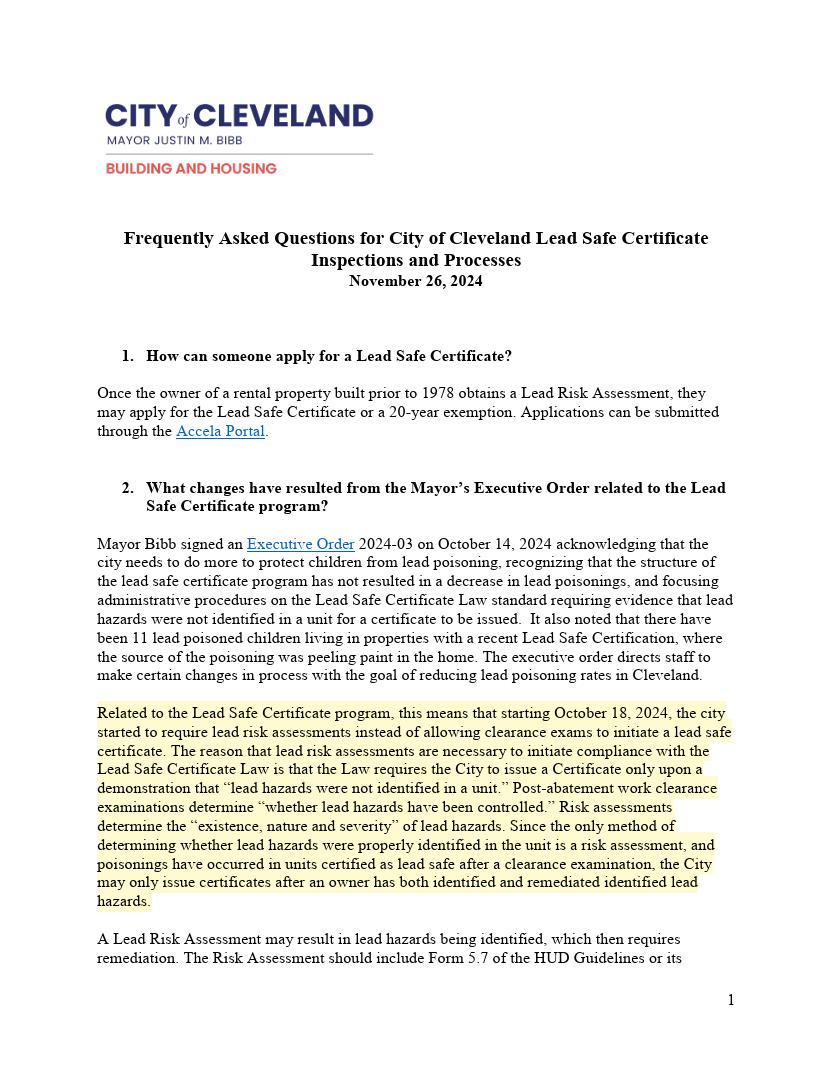
Click the image above to read the most recent Cleveland Lead Safe Certificate process FAQs and call Tri-County Inspections with your questions.
The videos below are no longer an accurate reflection of the current Cleveland Lead Inspection process. These videos were made by Tri-County Inspection's owner, operator and lead inspector, Mike Vakos, in early 2022 to demonstrate the process that was rolled out by the City of Cleveland in 2021. Since then, the process has gotten more involved in order to reduce lead poisoning rates in Cleveland but can provide some guidance for property owners to see what the initial process looked like. Until we create updated videos, we feel like these videos are still helpful to provide a general idea of the lead risk assessment process.